

Best Ethically Sourced Coffee Beans for Home in 2026
Table of Contents
- What Makes Coffee Ethically Sourced
- Fair Trade Coffee Certification Standards Explained
- The Benefits of Direct Trade Coffee for Farmers and Flavor
- How to Store Coffee Beans for Maximum Freshness
- Brewing Equipment and Packaging: The Sustainability Angles Most Buyers Miss
- Price-Per-Cup and Regional Flavor: What Ethical Beans Actually Cost You
- How to Verify Ethical Sourcing Claims Before You Buy
- Frequently Asked Questions
Last Updated: September 14, 2026
What Makes Coffee Ethically Sourced
Ethically sourced coffee is produced and traded under conditions that protect farmers, workers, and the environment from farm to roaster: fair compensation, safe labor, and farming methods that preserve soil and biodiversity.
This guide from Everline Coffee shows how to read labels, verify claims, and find the best ethically sourced coffee beans without overpaying for marketing.
Here's what most brand lists skip: a "sustainable" logo tells you almost nothing on its own. Certifications vary wildly in what they require, and some of the most ethical supply chains carry no seal at all.
The Core Criteria Behind Every Ethical Label
Four criteria separate genuine ethical sourcing from marketing: fair pay, verifiable traceability, environmental standards, and independent third-party verification. A bag meeting all four is worth its price; one meeting only one is usually a logo.
- Living wage: Farmers earn enough to cover basic needs, not just a market minimum
- Traceability: The bean's origin can be traced to a specific region, cooperative, or farm
- Environmental stewardship: Shade-grown methods, soil health, and biodiversity are protected
- Third-party verification: An independent body audits the claims, not the seller
Fair Trade Coffee Certification Standards Explained
Fair trade coffee certification standards are the audited requirements a farm or cooperative must meet to carry a fair trade label, covering minimum prices, labor conditions, and environmental practices. The label guarantees a floor, not a ceiling, and the floor differs by program.
What the Major Certifications Actually Require
These programs overlap but are not interchangeable, the differences matter in the grocery aisle.
Fairtrade International (Fairtrade America in the U.S.) sets a minimum price per pound that acts as a safety net when the market drops, plus a community development premium controlled by farmer cooperatives who vote on how to spend it, typically schools, clinics, or processing equipment. It also prohibits forced labor and the worst forms of child labor and requires democratic cooperative governance.
Fair for Life, administered by Ecocert, is a broader social and environmental certification covering an entire supply chain, not just the farm gate. It requires documented labor standards, fair pricing, and environmental management, and audits the roaster and importer as well as the producer, verifying parts of the chain Fairtrade doesn't reach.
Rainforest Alliance merged with UTZ in 2018 and runs a single standard focused on farm-level environmental practices: shade management, water use, pesticide reduction, and biodiversity. It uses a continuous-improvement model rather than a hard price floor, so it guarantees on-farm environmental practice more strongly than farmer income.
USDA Organic is not a fair trade certification, it governs how coffee is grown and processed (no synthetic fertilizers or pesticides, no prohibited substances for three years before harvest). A bag can be organic and still ethically questionable on labor, so treat it as one axis, not the whole picture.
| Certification | Price Floor? | Covers Labor? | Covers Environment? | Audits Beyond Farm? |
|---|---|---|---|---|
| Fairtrade International | Yes, plus premium | Yes | Partially | Cooperative level |
| Fair for Life | Yes, required | Yes | Yes | Yes, full chain |
| Rainforest Alliance | No hard floor | Yes | Yes | Farm and group level |
| USDA Organic | No | No | Yes | Farm and handler |
How to Read a Certification Claim Without Getting Fooled
A seal means a standard exists, not that it was met for this specific lot. Two habits close that gap:
- Check the certifier's public database. Fairtrade America, Fair for Life, and Rainforest Alliance all publish searchable lists of certified operators. If the roaster's name or the cooperative's name isn't there, the claim is unverified.
- Look for the license number. Legitimate certified products carry a license code, usually printed near the seal or on the back panel. A logo with no code is a graphic, not a certification.
The Fair Trade Certified standards overview outlines the pricing and labor requirements each program enforces. Certification bodies publish their own criteria, and the details change, so check the current standard before you trust a seal.
Where Certifications Fall Short
The most common criticism of certification is cost: audits and compliance fees burden smallholder farms, and some exemplary producers opt out entirely. So "uncertified" does not automatically mean "unethical", a roaster paying above-market prices to a named farm with no seal may do more for that farmer than a certified commodity buyer paying the floor.
The Benefits of Direct Trade Coffee for Farmers and Flavor
Direct trade coffee is a model where roasters buy straight from farmers or cooperatives, bypassing intermediaries and often paying above fair trade minimums. The benefits of direct trade coffee show up in farmer income and cup quality.
When a roaster builds a long-term relationship with a single farm, the farmer gets predictable income and feedback on bean quality. That loop rewards better growing and processing, which is why direct-relationship single-origin lots often taste more distinctive than commodity blends.
The catch: "direct trade" is not a regulated term. Any roaster can print it on a bag. Ask for the farm name, the region, and the harvest year. A roaster who can answer those questions is usually telling the truth.
How to Store Coffee Beans for Maximum Freshness
To store coffee beans for maximum freshness, keep them in an airtight, opaque container away from heat, light, and moisture, and buy quantities you'll finish within a few weeks. Oxygen and light are flavor's biggest enemies.
Whole beans stay fresh longer than ground because less surface area is exposed; grind right before brewing. A valve-sealed bag works for short-term storage; transfer to a ceramic or opaque canister once opened.
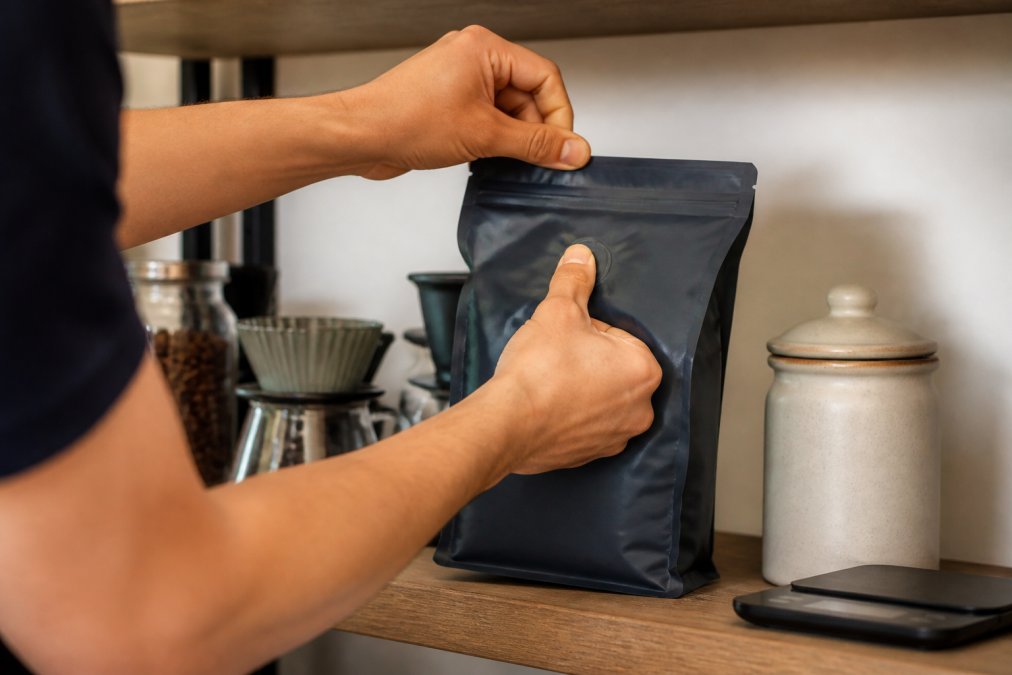
For long-term storage, freezing whole beans in an airtight container works, but let them come to room temperature before grinding. Repeated freeze-thaw cycles ruin beans, so portion them out first.
What to Do With the Bag When the Beans Are Gone
This is where ethical sourcing either holds up or falls apart. Most coffee bags are multi-layer laminates, plastic film bonded to foil or metallized polyester, designed to block oxygen. Those layers can't be separated at a typical municipal recycling facility, so a bag marked with a recycling symbol often still ends up in a landfill.
Here's how to sort out what you're actually holding:
- Kraft paper with a plastic or foil liner: Not curbside recyclable in most programs. Some roasters accept them back for reuse or take them to a specialty drop-off.
- Low-density polyethylene (LDPE, recycling code #4): Accepted by some store drop-off programs, but check locally, availability varies widely.
- Compostable bags (BPI-certified): Only break down in industrial composting facilities, not a backyard pile. If your municipality doesn't run one, they behave like conventional plastic.
- Returnable or refillable programs: The strongest option. A growing number of roasters take bags back, refill them, or ship in reusable containers.
A practical rule: if the bag has a foil sheen on the inside, assume landfill unless the roaster says otherwise. If it's plain kraft with a paper-only liner, it can often go in curbside recycling or a compost stream.
Price-Per-Cup: The Number That Actually Justifies the Premium
Ethical coffee looks expensive by sticker price, but the honest comparison is cost per cup, not cost per bag, specialty-grade beans are denser and more consistent, so you use fewer grams per brew and waste less.
Run the math yourself:
- Divide the bag price by the number of cups it yields. A 12-ounce bag at roughly 18 grams per brewed cup yields about 19 cups.
- Compare that number to your current bag. A $16 bag yielding 19 cups is about $0.84 per cup. A $12 bag yielding 14 cups is about $0.86 per cup, the "cheaper" bag costs more per morning.
- Factor in waste. Bags you don't finish because the flavor isn't right are pure loss. Choosing a region you actually like (see below) reduces that waste directly.
Pricing for any specific bag depends on origin, roast, and quantity, so check the roaster's site for current figures rather than trusting a number in an article.
Match the Region to Your Palate Before You Buy
Buying a region you don't enjoy is the fastest way to waste money on ethical beans. Ethiopian beans tend toward floral and fruity notes; Colombian beans are balanced and caramel-sweet; Sumatran beans run earthy and full-bodied.
- Ethiopia: Floral, citrus, berry
- Colombia: Balanced, caramel, nutty
- Sumatra: Earthy, herbal, full-bodied
- Brazil: Chocolate, nutty, low acidity
Between proper storage, responsible packaging disposal, and realistic price-per-cup math, the ethical premium stops looking like a luxury and starts looking justifiable.
Brewing Equipment and Packaging: The Sustainability Angles Most Buyers Miss
Coffee's sustainability doesn't end at the bean. Brewing equipment and packaging carry their own footprint, and most buyer's guides ignore both, this is where a thoughtful purchase separates from a greenwashed one.
On equipment: a durable pour-over dripper or French press lasts years with no waste per cup, while single-serve pod machines generate a pod per cup, and even "compostable" pods often land in landfills because municipal facilities can't process them.
On packaging: many coffee bags combine plastic and foil layers that can't be recycled curbside. Bags labeled recyclable or compostable, or returnable to the roaster, close the loop. Everline Coffee's precision roasting process and fresh-roasted model mean beans ship close to roast date, so you're not paying for stale inventory that gets thrown out.
Price-Per-Cup and Regional Flavor: What Ethical Beans Actually Cost You
Price-per-cup is the honest way to compare coffee: a bag costing more upfront often costs less per cup because specialty-grade beans are denser and you use fewer grams per brew. Divide bag price by cups yielded, not by bag weight.
Choosing a region you actually like means less waste from unfinished bags. Ethiopian beans tend toward floral and fruity notes; Colombian beans are balanced and caramel-sweet; Sumatran beans run earthy and full-bodied.
- Ethiopia: Floral, citrus, berry
- Colombia: Balanced, caramel, nutty
- Sumatra: Earthy, herbal, full-bodied
- Brazil: Chocolate, nutty, low acidity
Pricing for any specific bag depends on origin, roast, and quantity, so check the roaster's site for current figures rather than trusting a number in an article.
How to Verify Ethical Sourcing Claims Before You Buy
Verifying ethical sourcing claims means checking the certification against the certifier's database, confirming the farm or cooperative is named, and looking for third-party verification rather than self-reported claims. A logo alone proves nothing.
Run this checklist before you buy:
- Is the certification listed on the certifier's official database?
- Does the bag name a specific farm, cooperative, or region?
- Is there a roast date, not just a best-by date?
- Does the roaster publish sourcing details on their site?
- Is the packaging recyclable, compostable, or returnable?
The USDA organic certification program is a useful cross-check for organic claims, and Fairtrade America's certification guide lets you confirm a fair trade seal is legitimate. A roaster who passes all five checks is one you can trust.
If you want a starting point, Everline Coffee publishes roast dates and sources fresh-roasted beans, which makes the freshness half of this checklist easy to verify.
The hardest part of buying ethical coffee isn't finding a label, it's trusting one. Everline Coffee takes the guesswork out by offering fresh roasted coffee beans, premium specialty blends, and high-quality artisan coffee with a precision roasting process built for consistent, balanced flavor. Subscribe to our emails and get ethically sourced beans delivered fresh, so your morning cup is one less thing to second-guess.
Frequently Asked Questions
What are ethically sourced coffee beans?
Ethically sourced coffee beans are grown and traded under conditions that protect farmers, workers, and the environment. This typically means fair prices above commodity rates, safe labor practices, no child labor, and farming methods that preserve soil and biodiversity. Certifications like Fairtrade, Fair for Life, and Rainforest Alliance verify many of these standards through third-party audits. Direct trade relationships between roasters and farms can achieve similar outcomes without a formal seal, provided the roaster publishes verifiable details about who grew the coffee and what was paid.
How can I verify if a coffee brand is truly fair trade?
Check for a certification mark on the bag, then verify it on the certifier's own website rather than trusting the label alone. Fairtrade International and Fair for Life both maintain searchable databases of certified operators. Look for a certification ID number, the year of the most recent audit, and whether the certification covers the specific product you're buying. If a roaster claims fair trade without a seal, ask for the farm name, the cooperative, and the price paid per pound. Brands that answer those questions directly are usually the ones worth buying from.
What is the difference between direct trade and fair trade coffee?
Fair trade relies on third-party certification: an independent auditor confirms that cooperatives meet price, labor, and environmental standards. Direct trade skips the certification body and instead builds a direct relationship between roaster and farm, often paying above fair trade minimums. The benefits of direct trade coffee include fresher harvests, more money reaching the grower, and flavor profiles tied to specific farms. The tradeoff is that direct trade claims are harder to verify, so you rely on the roaster's transparency rather than an outside seal.
How does ethical sourcing impact the flavor profile of coffee?
Ethical sourcing often correlates with better flavor because the same practices that protect farmers also protect bean quality. Shade-grown and bird-friendly farms ripen cherries more slowly, which concentrates sugars and produces more complex cup profiles. Direct trade relationships give roasters access to single-origin lots and experimental processing methods they could not get through commodity channels. Regions matter too: East African beans tend toward bright, fruity notes, while Central and South American beans often deliver chocolate and caramel. Paying farmers well also means they can invest in better picking and processing.