

Fresh Coffee Beans Delivered: 2026 Buyer's Guide
Table of Contents
- What Fresh Coffee Beans Delivered to Home Actually Means
- Why roast date matters more than the label
- How to read a bag before you buy
- Coffee Bean Roast Dates Explained (Without the Confusion)
- How to Choose Coffee Beans for Your Brewing Method
- How to Store Coffee Beans for Maximum Freshness After Delivery
- What to Look for in a Fresh Coffee Beans Delivery Service
- A Simple Way to Start: Sample Packs and First Orders
- Frequently Asked Questions
Last Updated: September 16, 2026
What Fresh Coffee Beans Delivered to Home Actually Means
Fresh coffee beans delivered to home is a service that ships whole bean coffee within days of roasting, so the bag that lands on your counter still tastes the way the roaster intended. Most grocery store bags sit in a warehouse for months before you ever see them.
The difference shows up in the cup. Coffee starts losing its best qualities within weeks of roasting, not months. Oxygen, light, and moisture all work against the oils that carry aroma and flavor.
Below, we'll show you exactly how to read a roast date, match beans to your brewer, and pick a delivery schedule that fits a 6 AM routine.
Why roast date matters more than the label
"Best by" tells you almost nothing. A roast date tells you everything.
Many roasters print a best-by date months out from roasting, which protects the retailer more than it protects your cup. A roast date is the honest number. If a bag shows only a best-by date, treat that as a warning sign and ask the roaster directly when the beans were roasted.
How to read a bag before you buy
Four things on a label tell you whether the coffee inside is worth your money:
- Roast date, printed as an actual calendar date, not a code
- Origin details, including region, farm, or cooperative
- Processing method, such as washed, natural, or pulped natural
- Roast level, listed as light, medium, or dark
Coffee Bean Roast Dates Explained (Without the Confusion)
Coffee bean roast dates explained simply: the roast date is the day the beans finished roasting, and it is the single most useful number on the package. Coffee is at its best roughly 4 to 14 days after roasting for most brewing methods.
Specialty Coffee Association guidance on freshness and storage
How to Choose Coffee Beans for Your Brewing Method
The right bean depends on how you brew it. There is no universal best coffee, only the best match between roast level, grind size, and your equipment.
Grind size and roast level by brewer
| Brewer | Grind Size | Best Roast Level | Why |
|---|---|---|---|
| Espresso | Fine | Dark or medium-dark | High pressure needs a fine, even bed |
| Pour-over | Medium-fine | Light or medium | Slower flow rewards brighter acidity |
| Drip machine | Medium | Medium | Consistent extraction, forgiving |
| French press | Coarse | Medium or dark | Metal filter needs larger particles |
| Cold brew | Coarse | Medium or light | Long steep, low bitterness |
If you are unsure where to start, a medium roast handles every method on that list without embarrassing you. Our Single Origin Favorites Sample Pack at $24.99 includes six 2oz packs spanning medium to medium-light roasts, which makes it an easy way to test what your brewer likes.

How to Store Coffee Beans for Maximum Freshness After Delivery
Storage is where most delivered-bean value is won or lost. The goal is simple: slow oxidation and keep moisture out. How you do it depends on how fast you drink.
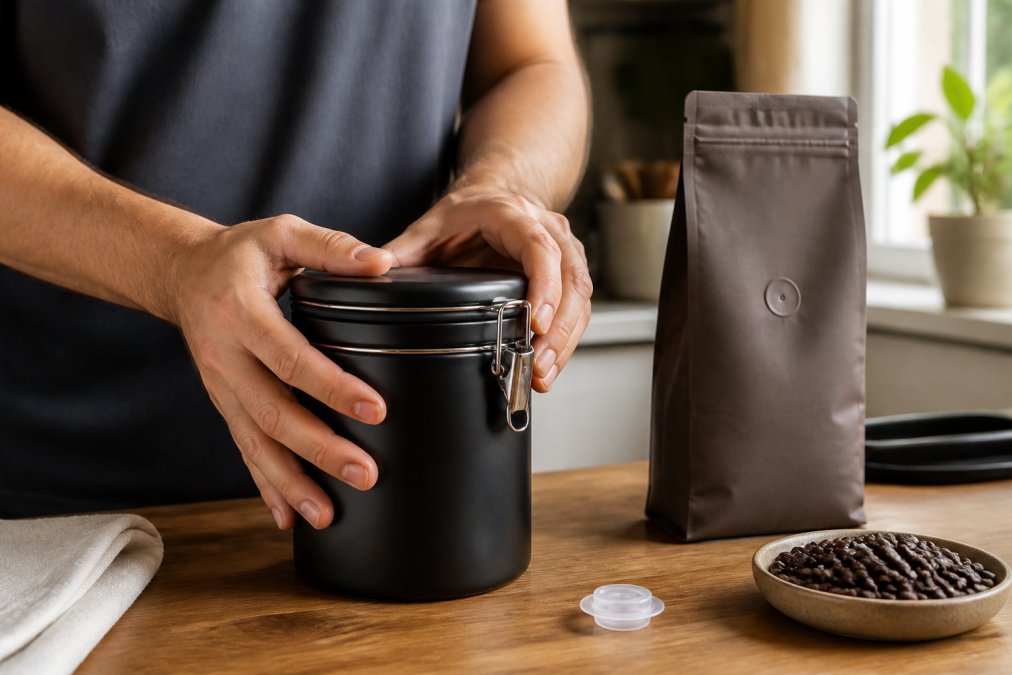
Match the container to your consumption speed
- Drinking within 2-3 weeks: Keep beans in the original valve-sealed bag, squeezed to push out air, clipped or zipped shut, in a cool cupboard. The one-way valve lets carbon dioxide escape without letting oxygen in, which is exactly what you want during the degassing window.
- Drinking over 4-6 weeks: Move to an opaque, airtight canister with a tight gasket. Clear glass looks nice on a shelf but lets light degrade the oils that carry aroma.
- Buying more than you'll finish in 6 weeks: Freeze the surplus in a vacuum-sealed or tightly pressed airtight bag, in portions sized to about a week of brewing.
Why the freezer is a tool, not a default
The problem with freezing daily-use beans isn't cold, it's cycling. Every time you open the bag, warm room air hits cold beans and condenses. That surface moisture is worse for flavor than steady room temperature. The fix is portioning: freeze in week-sized lots, take one out, let it come to room temperature sealed before opening, and never refreeze.
The variable almost no guide mentions: your water
Here's the angle most delivery guides skip. The beans can arrive perfect and still taste flat if your water is wrong. Brewed coffee is roughly 98% water, so mineral content drives extraction.
- Too soft or distilled water under-extracts. You get a thin, sour, tea-like cup because there aren't enough minerals to pull solubles from the grounds.
- Very hard water over-extracts and mutes acidity. You get chalky, dull, bitter notes and scale buildup in your kettle and brewer.
- The target range most specialty practitioners aim for is roughly 50-150 ppm total dissolved solids, with some magnesium and calcium present for extraction and a little alkalinity to buffer acidity.
What to Look for in a Fresh Coffee Beans Delivery Service
A delivery service is really two promises: it ships fast enough to matter, and it makes problems right when they happen. Most guides cover the first and ignore the second. Both matter.
The four things that separate a roaster-direct operation from a warehouse reseller
- Roast-to-ship time. The best operations roast and ship within 24-48 hours. Ask directly, or look for a roast date on the bag that's within a few days of the delivery date. If the bag arrives with a roast date two weeks old, the shipper isn't prioritizing freshness.
- Packaging with a one-way valve. A valve-sealed bag with a roast date printed on it is the baseline. A plain bag with only a best-by date is a red flag.
- Schedule control without a phone call. You should be able to pause, skip, swap, or resize a shipment from your account. A plan you can't pause is a plan that buries you in beans.
- Origin and process transparency. Region, farm or cooperative, processing method (washed, natural, honey), and roast level should all be on the label or product page. A bag missing two or more of those is a bag to skip.
U.S. Food and Drug Administration guidance on food storage and labeling
What to do when a delivery goes wrong
This is the part competitors skip, and it's where a good roaster earns your loyalty.
Don't wait to report a problem. Freshness complaints are time-sensitive, a roaster can only verify a stale shipment if you flag it close to the delivery date.
The flexibility checklist before you subscribe
Before you commit to a recurring plan, confirm you can:
- Change delivery frequency (weekly, biweekly, monthly)
- Skip a shipment without canceling
- Swap roast levels or origins between shipments
- Pause for a vacation
- Cancel without a fee or a phone call
A Simple Way to Start: Sample Packs and First Orders
Sample packs remove the guesswork from your first order. Instead of committing to a full bag you might not love, you try several roasts in small amounts and reorder only the winners.
Anyone who wants to find their roast before committing to a recurring delivery.
Frequently Asked Questions
How do I know my coffee beans are actually fresh when they arrive?
Check the roast date printed on the bag, not just the best-by date. Fresh coffee beans are typically at their peak 4 to 14 days after roasting. Look for valve-sealed bags, which let carbon dioxide escape without letting oxygen in. If the bag has no roast date, treat that as a red flag. A quick test: freshly roasted whole beans smell sweet and complex, while stale beans smell flat or papery.
How long do coffee beans stay fresh after roasting?
Whole bean coffee is generally best within 2 to 4 weeks of the roast date, though it stays drinkable longer. After about 6 weeks, flavor and aroma drop noticeably. Ground coffee loses freshness much faster, often within days, because more surface area is exposed to oxygen. Storing whole beans in an airtight, opaque container away from heat and light helps you get the most from each bag.
Is it better to buy coffee beans online or from a local roaster?
Both can work well. A local roaster lets you buy the same day it is roasted, but selection and delivery convenience vary. Online ordering gives you access to a wider range of single-origin and small-batch options, and many services ship within 24 to 48 hours of roasting. The deciding factor is the roast date, not the distance. If the beans arrive within a few days of roasting, online delivery can match or beat a local shop.
What should I look for in a coffee subscription service?
Prioritize a clear roast date, fast shipping, and flexible frequency. Good services let you pause, skip, or change your delivery schedule without penalties. Check whether they offer whole bean and ground options, and whether you can pick roast levels or origins. Sample packs are a low-risk way to test a roaster before committing to a recurring plan. Also confirm the packaging uses valve-sealed bags to protect freshness in transit.
Finding coffee that tastes as good on day 20 as it did on day 2 comes down to roast date, storage, and a roaster who ships fast. Everline Coffee roasts in small batches and delivers fresh roasted beans with a precision roasting process built for consistent, balanced flavor, so your morning cup does not depend on luck. Start with a sample pack, find your roast, then set a delivery schedule that keeps pace with your routine. Subscribe to our emails and get your first order moving.