

How to Tell If Coffee Beans Are Fresh: 7 Tests
Table of Contents
- Why Freshness Determines Your Coffee's Flavor
- The Bloom Test: Your First Freshness Check
- Aroma and Visual Inspection: Sensory Clues
- The Best Time to Brew Coffee After Roasting
- Signs of Stale Coffee Beans to Watch For
- How to Store Coffee Beans for Maximum Freshness
- Advanced Freshness Factors: Density, Freezing, and Water
- Troubleshooting Stale Beans
- Frequently Asked Questions
Last Updated: September 15, 2026
Why Freshness Determines Your Coffee's Flavor
Freshly roasted coffee is a perishable product, not a pantry staple. The moment beans leave the roaster, they begin releasing carbon dioxide and slowly oxidizing, and both processes strip away the aromatic compounds that make a cup taste vivid rather than flat. Learning how to tell if coffee beans are fresh is the single highest-use skill a home brewer can develop, because no grinder or brewing method can rescue beans that have already gone stale. At Everline Coffee, we roast in small batches and ship quickly so the beans arrive inside their peak window, but you still need to know how to verify freshness yourself.
The good news: you don't need lab equipment. Your nose, your eyes, and a simple pour-over test will tell you almost everything.
The Bloom Test: Your First Freshness Check
The bloom test is the fastest way to gauge freshness: pour hot water over fresh grounds and watch how much the coffee swells and bubbles. Fresh beans release trapped carbon dioxide on contact with water, producing a thick, foamy dome. Stale beans barely react.
Here's how to run it:
- Grind 15-20 grams of beans to a medium-coarse setting.
- Place the grounds in a pour-over dripper or a mug.
- Pour water just off the boil (about 200-205°F) over the grounds.
- Watch for 30 seconds.
A lively bloom with lots of foamy bubbles signals active degassing, a strong sign of freshness. A weak, flat reaction means much of that gas has already escaped.
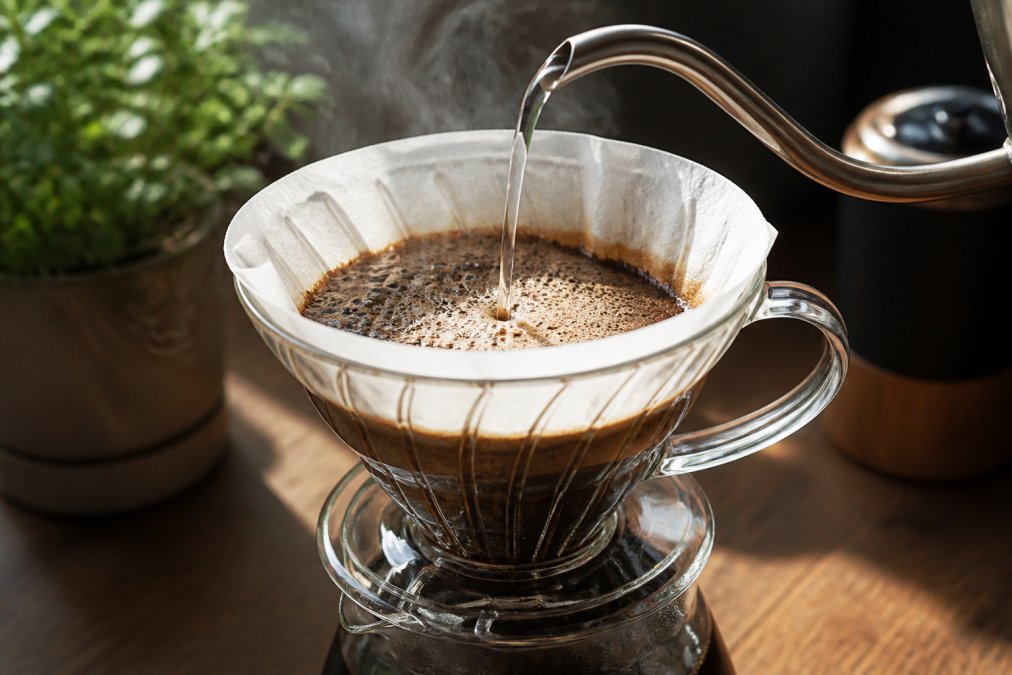
The bloom isn't just a freshness test. It's also why baristas "bloom" coffee deliberately: letting the gas escape first allows water to extract flavor evenly instead of being pushed away by trapped carbon dioxide.
Aroma and Visual Inspection: Sensory Clues
Your nose catches staleness before your palate does. Fresh beans smell fragrant and complex, often with notes of fruit, chocolate, or caramel depending on the roast. Stale beans smell dull, papery, or faintly like cardboard.
Visual inspection adds a second layer:
- Glossy shine: A light sheen of oil on darker roasts is normal and often a sign of recent roasting. Heavy oil residue combined with a dusty surface can indicate age.
- Color consistency: Even coloring across the batch suggests a controlled roast. Uneven, patchy beans point to a sloppy roast profile.
- Surface texture: Fresh beans look matte to lightly glossy. Very dry, cracked-looking beans have usually lost their moisture.
Sensory evaluation works best when you combine smell and sight. If the aroma is weak and the beans look dry and pale, trust that impression over the roast date alone.
The Best Time to Brew Coffee After Roasting
The best time to brew coffee after roasting is generally 4 to 14 days post-roast, after the beans have had a short resting period to degas. Brew too soon and the escaping carbon dioxide interferes with extraction, giving you a sour, uneven cup. Wait too long and oxidation takes over.
This window shifts with the roast level:
| Roast Level | Peak Window | Why |
|---|---|---|
| Light roast | 7-14 days | Denser beans, slower degassing |
| Medium roast | 5-12 days | Balanced gas release |
| Dark roast | 3-7 days | Porous beans, faster staling |
Dark roasts peak sooner because the roasting process makes the beans more porous, so they release gas and oxidize faster. Light roasts hold their peak longer thanks to their density. If you're coming from grocery-store coffee, this timeline may surprise you, but it's the difference between a punchy, layered cup and a hollow one.
Signs of Stale Coffee Beans to Watch For
Stale coffee announces itself in predictable ways once you know the signals. Watch for these signs of stale coffee beans:
- No bloom: Water sits flat on the grounds with little to no bubbling.
- Papery taste: The cup tastes thin, dry, or vaguely like cardboard.
- Hollow body: The coffee feels watery in the mouth, missing the syrupy weight of fresh beans.
- Faint or rancid aroma: Old oils can turn rancid, giving an unpleasant, greasy smell.
- Dull color: Beans look faded rather than richly colored.
A common mistake is blaming your brewing method when the real problem is the beans. If your technique hasn't changed but the cup suddenly tastes flat, check the roast date before you touch your grinder settings.
How to Store Coffee Beans for Maximum Freshness
Learning how to store coffee beans for maximum freshness comes down to blocking three enemies: oxygen, moisture, and light. Get those under control and you'll extend the peak window significantly. The difference between a bag that tastes vivid on day 20 and one that tastes flat on day 8 is almost always storage, not roast quality.
The core rules:
- Keep beans in an airtight container, ideally opaque and ceramic or stainless steel.
- Store at room temperature, away from the stove, oven, or sunny windowsills.
- Buy whole beans and grind just before brewing to protect flavor.
- Choose bags with a one-way valve, which lets carbon dioxide escape without letting oxygen in.
Why the one-way valve matters. After roasting, beans release carbon dioxide for days. A sealed bag with no valve would inflate and eventually force gas out through the seams, pulling oxygen back in as pressure equalizes. A one-way valve lets CO2 escape while blocking the reverse flow of oxygen. That's why a bag that's still puffed up when you open it is a good sign, and a bag that's been vacuum-flattened for weeks is usually a bad one.
Container choice, ranked by what actually works:
- One-way valve bag, rolled and clipped. The bag the coffee shipped in is often the best container you own. Squeeze out excess air, roll the top down, and clip it. Cheap, effective, and preserves the valve.
- Opaque airtight canister with a valve. Ceramic or stainless steel blocks light and the valve handles degassing. Avoid clear glass jars on open shelves, light accelerates oxidation of the oils.
- Vacuum-sealed canisters. These pull a partial vacuum to slow oxidation. Useful for beans you'll finish within a week, but the pumping action introduces a small amount of fresh air each cycle.
- Original bag, folded but unclipped. Common default, and the reason most people's coffee fades fast. Air exchange is constant.
Avoid the refrigerator for daily storage. Every time you open the door, temperature swings introduce moisture, and moisture accelerates staling. Coffee beans are hygroscopic, they readily absorb ambient moisture and odors. A refrigerator also exposes beans to whatever else is in there, which is why refrigerator-stored coffee often picks up a faint savory or cardboard note.
Buy in quantities you'll finish. A smaller bag you actually finish beats a bulk bag that goes stale on the shelf. For most households brewing one or two cups a day, a 12-ounce bag lasts roughly two to three weeks, which lines up well with the peak window. If you brew less often, buy smaller or split a larger bag into portions and freeze the rest.
A note on grind timing. Pre-ground coffee exposes vastly more surface area to oxygen, so it stales in hours rather than weeks. If you can only make one equipment upgrade, a burr grinder will do more for perceived freshness than any storage container.
Advanced Freshness Factors: Density, Freezing, and Water
Three factors separate a good cup from a great one, and most guides skip them entirely. Each one explains why two bags with the same roast date can taste weeks apart.
Bean density shapes how fast coffee ages. High-grown beans, typically those cultivated at higher elevations where slower cherry development produces denser cell structure, degas more slowly and hold their flavor longer than porous, low-density beans.
The protocol that works:
Specialty Coffee Association guidance on water standards
Troubleshooting Stale Beans
Frequently Asked Questions
What is the freshest coffee you can buy?
The freshest coffee you can buy is typically from a local roaster or a subscription service that ships within days of roasting. Look for a roast date on the bag, not just a best-by date. Ideally, you want beans roasted within the past 7 to 14 days. Everline Coffee, for example, roasts to order and ships quickly to ensure you receive beans at their peak. Avoid supermarket beans with no roast date, as they may have been sitting on shelves for months.
How long will coffee beans remain fresh?
Whole coffee beans stay fresh for about 2 to 4 weeks after the roast date if stored in an airtight container away from light, heat, and moisture. After that, they begin to lose flavor and aroma. For maximum freshness, use them within 2 weeks. If you buy in bulk, consider freezing half the beans in an airtight container to extend shelf life up to 2 months. Ground coffee goes stale much faster, often within days.
Are 2-year-old coffee beans still safe to drink?
Two-year-old coffee beans are safe to drink if they have been stored properly and show no signs of mold or pests. However, they will taste stale, flat, and possibly rancid due to oxidation of oils. The flavor will be dull with papery or cardboard notes. While not harmful, they won't deliver a enjoyable cup. For better results, use them for baking or compost them and buy fresh beans.
Does the roast date on the bag really matter?
Yes, the roast date is the single most important indicator of freshness. Unlike a best-by date, which can be months after roasting, the roast date tells you exactly when the beans were roasted. Coffee begins to degas and oxidize immediately after roasting. Peak flavor occurs about 4 to 14 days after roasting, depending on the bean. Always choose bags with a clearly printed roast date and buy from roasters who prioritize freshness.